
Every Website Owner Should Understand These 5 Google SEO Algorithms
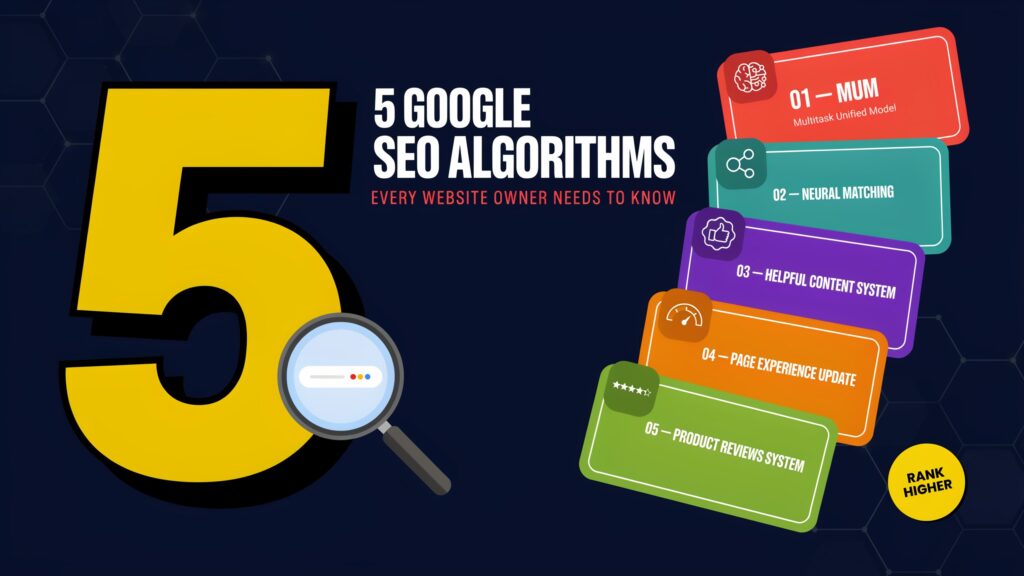
In order to give users the most pertinent, accurate, and useful results, Google constantly enhances its search engine. While many marketers are familiar with updates like Panda, Penguin, Hummingbird, RankBrain, and BERT, several other Google ranking systems have become equally important in modern SEO. Website owners can successfully optimize their content and retain high search exposure by comprehending these algorithms.
Below are five important Google algorithms and ranking systems that every digital marketer should understand.
1. MUM (Multitask Unified Model)
Google introduced MUM (Multitask Unified Model) in 2021 as one of its most advanced artificial intelligence technologies. Unlike earlier search systems, MUM can understand information across multiple languages and different content formats, including text and images. It is designed to answer complex search queries by connecting information from multiple sources rather than relying on a single webpage.
For example, if someone searches for advice on preparing for a mountain hike, MUM can understand related topics such as weather conditions, equipment recommendations, and travel information without requiring multiple separate searches.
Why MUM Matters
- Understands complex search intent.
- Connects information across multiple languages.
- Supports text and image-based search.
- Delivers more comprehensive search results.
SEO Best Practices
- Publish detailed and informative content.
- Cover related subtopics within one article.
- Use relevant images with descriptive alt text.
- Build topical authority by creating content clusters.
2. Neural Matching
Neural Matching is Google’s artificial intelligence system that helps connect search queries with the most relevant web pages, even when the exact keywords do not appear in the content. Instead of focusing only on keyword matching, Neural Matching understands concepts and relationships between words.
For instance, if a user searches for “ways to reduce electricity bills,” Google can identify pages discussing energy-saving techniques even if those exact words are not used.
Why Neural Matching Matters
- Improves understanding of search intent.
- Connects related concepts instead of exact keywords.
- Delivers more relevant search results.
- Helps Google understand synonyms and contextual meaning.
SEO Best Practices
- Write naturally without keyword stuffing.
- Include related terms and semantic keywords.
- Focus on solving user problems.
- Content should be arranged logically and with distinct headings.
3. Helpful Content System
Google introduced the Helpful Content System to reward websites that create content primarily for people rather than search engines. The method finds content that shows true expertise, utility, and creativity rather than rating pages with low-value information or repetitive keywords.
Websites that consistently publish informative and trustworthy articles are more likely to benefit from this system.
Why It Matters
- Rewards user-focused content.
- Identifies low-quality or repetitive articles.
- Encourages original writing.
- Promotes expertise and trustworthiness.
SEO Best Practices
- Create content based on real experience.
- Answer user questions thoroughly.
- Avoid publishing thin or duplicate articles.
- Update existing content regularly to maintain accuracy.
4. Page Experience Update
The Page Experience Update emphasizes the importance of providing visitors with a smooth and enjoyable browsing experience. Besides high-quality content, Google also evaluates how quickly a page loads, how stable the layout remains during loading, and whether the website is mobile-friendly and secure.
A satisfying user experience lowers bounce rates and increases overall engagement by enticing visitors to remain longer.
Why Page Experience Matters
- Improves website usability.
- Rewards faster-loading websites.
- Encourages responsive mobile design.
- Supports secure browsing with HTTPS.
SEO Best Practices
- Optimize page loading speed.
- Improve Core Web Vitals.
- Ensure mobile responsiveness.
- Minimize unexpected layout shifts.
- Compress images without reducing quality.
5. Product Reviews System
The Product Reviews System is designed to highlight high-quality review content that provides genuine insights and valuable information for users. Instead of rewarding short or generic reviews, Google prioritizes reviews that demonstrate hands-on experience, detailed analysis, and original recommendations.
Although this system mainly affects review-based websites, its principles also encourage businesses to create authentic and informative product content.
Why Product Reviews Matter
- Rewards detailed and original reviews.
- Encourages first-hand product experience.
- Improves trust among readers.
- Helps users make informed purchasing decisions.
SEO Best Practices
- Write honest and unbiased reviews.
- Include original images whenever possible.
- Compare products objectively.
- Explain both advantages and disadvantages.
- Support recommendations with real evidence and practical examples.
Conclusion
Google’s search algorithms are constantly changing, with a focus on user pleasure, quality, and relevancy. Modern SEO is no longer about targeting exact keywords or relying on outdated optimization techniques. Instead, systems such as MUM, Neural Matching, Helpful Content System, Page Experience Update, and Product Reviews System reward websites that provide valuable information, excellent user experiences, and trustworthy content.
By focusing on comprehensive articles, improving website performance, and creating original content that genuinely helps users, businesses can build sustainable search rankings and remain competitive in Google’s ever-changing search landscape. This people-first approach not only improves SEO performance but also establishes long-term credibility and trust with audiences.
Are You Ready to Rise in Search Results?
To increase your website’s search performance and fortify your SEO strategy, get in touch with Goutham Krishna R. The proper strategy may help your company achieve higher results, draw in qualified traffic, and produce long-term growth by optimizing content, improving user experience, and putting smart SEO strategies into practice. A results-focused SEO approach can help convert website visitors into devoted clients, regardless of your objective—increasing organic visibility, generating more leads, or strengthening your online presence.