
SEO vs GEO: What’s the Difference and Why Your Business Needs Both in 2026
Introduction
Not long ago, most of us opened Google, typed a few keywords, and clicked through different websites to find answers. Today, many people ask AI tools like ChatGPT, Gemini, or Perplexity direct questions and receive complete answers in seconds.
This shift is changing digital marketing forever.
If your business wants to stay visible online in 2026, ranking on Google alone is no longer enough. You also need to appear in AI-generated answers. That’s where understanding the difference between Search Engine Optimization (SEO) and Generative Engine Optimization (GEO) becomes essential.
Let’s explore what they are, how they differ, and why your business should invest in both.
What is Search Engine Optimization (SEO)?
Search Engine Optimization (SEO) is the process of improving your website so it ranks higher on search engines like Google when people search for products, services, or information.
The goal of SEO is simple: help your website appear in front of the right audience at the right time.
A strong SEO strategy includes:
- Keyword research
- High-quality content
- Fast website performance
- Mobile-friendly design
- Quality backlinks
- Technical optimization
- Excellent user experience
For example, if someone searches for “best digital marketing expert in Kerala,” SEO helps your website appear among the top search results.
The higher your ranking, the more organic traffic, leads, and potential customers your business can attract.
What is Generative Engine Optimization (GEO)?
Generative Engine Optimization (GEO) is a newer digital marketing strategy focused on helping AI-powered search platforms understand and recommend your content.
Instead of showing users a list of links, AI tools generate complete answers by collecting information from multiple trusted sources.
Your goal with GEO is to make your content useful, trustworthy, and easy for AI systems to understand and reference.
GEO focuses on:
- Clear and well-structured content
- Answering real user questions
- Building topical authority
- Using conversational language
- Publishing original insights
- Demonstrating expertise and credibility
- Maintaining accurate and updated information
When someone asks an AI platform,
Who is the top small company consultant for digital marketing?
the AI may recommend businesses whose content is detailed, reliable, and optimized for AI understanding.
That is the power of GEO.
SEO vs GEO: What’s the Difference?
While increasing internet visibility is a common objective of both SEO and GEO, their methods differently.
SEO focuses on search engine rankings.
It aims to help your website appear at the top of Google search results through keywords, technical optimization, backlinks, and website performance.
GEO focuses on AI-generated answers.
Instead of competing only for rankings, it helps your content become part of the answers generated by AI assistants.
Think of it this way:
SEO helps users find your website.
GEO helps AI recommend your business.
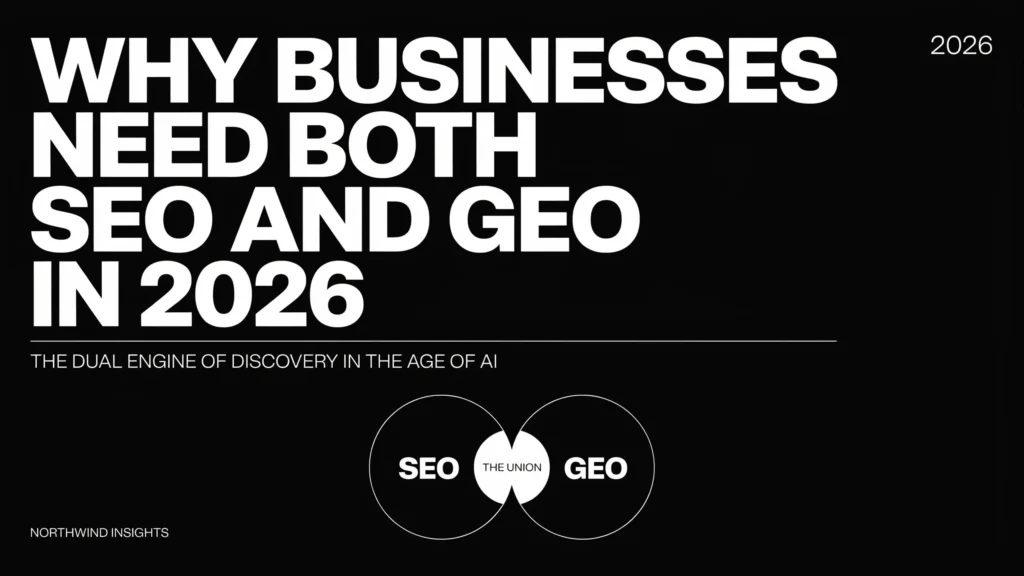
The smartest businesses in 2026 are optimizing for both.
Why Businesses Need Both SEO and GEO in 2026
The customer journey is changing.
Some people still search on Google.
Others ask ChatGPT. Some use Gemini.
Others rely on Perplexity.
Customers now expect instant, accurate answers wherever they search.
If your business only focuses on traditional SEO, you’re missing an entire audience using AI-powered search.
By combining SEO and GEO, you can:
- Reach customers across multiple search platforms
- Increase brand visibility
- Build authority and trust
- Generate higher-quality leads
- Future-proof your marketing strategy
- Stay ahead of competitors who rely only on Google rankings
The businesses that adapt early will gain a significant advantage.
How SEO and GEO Work Together
Many business owners think they need to choose one strategy.
In actuality, they enhance one another.
When you publish valuable, well-organized content, improve website speed, answer customer questions, and demonstrate expertise, you’re strengthening both SEO and GEO.
A blog post that ranks well on Google can also become a trusted source for AI-generated responses.
Likewise, content designed to answer detailed questions naturally performs better in traditional search results.
Rather than treating them as separate strategies, think of SEO and GEO as two sides of the same digital marketing approach.
Simple Ways to Optimize for Both
You don’t need to rebuild your entire website.
Start with these practical steps:
Focus on helping users before trying to rank.
Start with these practical steps:
- Write content that answers real customer questions.
- Use clear headings and logical content structure.
- Keep your information accurate and regularly updated.
- Publish original insights instead of copying competitors.
- Improve your website’s speed and mobile experience.
- Build trust through testimonials, case studies, and author credibility.
- Cover topics in depth instead of creating thin content.
When your content genuinely solves problems, both search engines and AI platforms are more likely to recommend it.
The Future of Search is Hybrid
There is no longer just one platform for search.
People move between Google, AI assistants, voice search, and social media before making buying decisions.
Businesses that understand this shift are creating content that works everywhere.
Instead of asking, “Should I focus on SEO or GEO?”
The better question is:
“How can my material benefit clients no matter where they decide to look?”
That mindset will define successful digital marketing in the years ahead.
Conclusion
SEO is still one of the most effective ways to drive organic traffic, but the rise of AI-powered search has introduced a new opportunity. Generative Engine Optimization (GEO) helps your business appear in AI-generated recommendations, expanding your reach beyond traditional search results.
In 2026, businesses that combine SEO and GEO will be better positioned to connect with customers, build trust, and generate consistent leads. By creating valuable, well-structured, and user-focused content, you can strengthen your visibility across both search engines and AI platforms.
The future of online search isn’t about choosing one strategy over the other—it’s about making your business discoverable wherever your audience is looking.
Ready to grow your business online?
Let’s connect and build your success story.